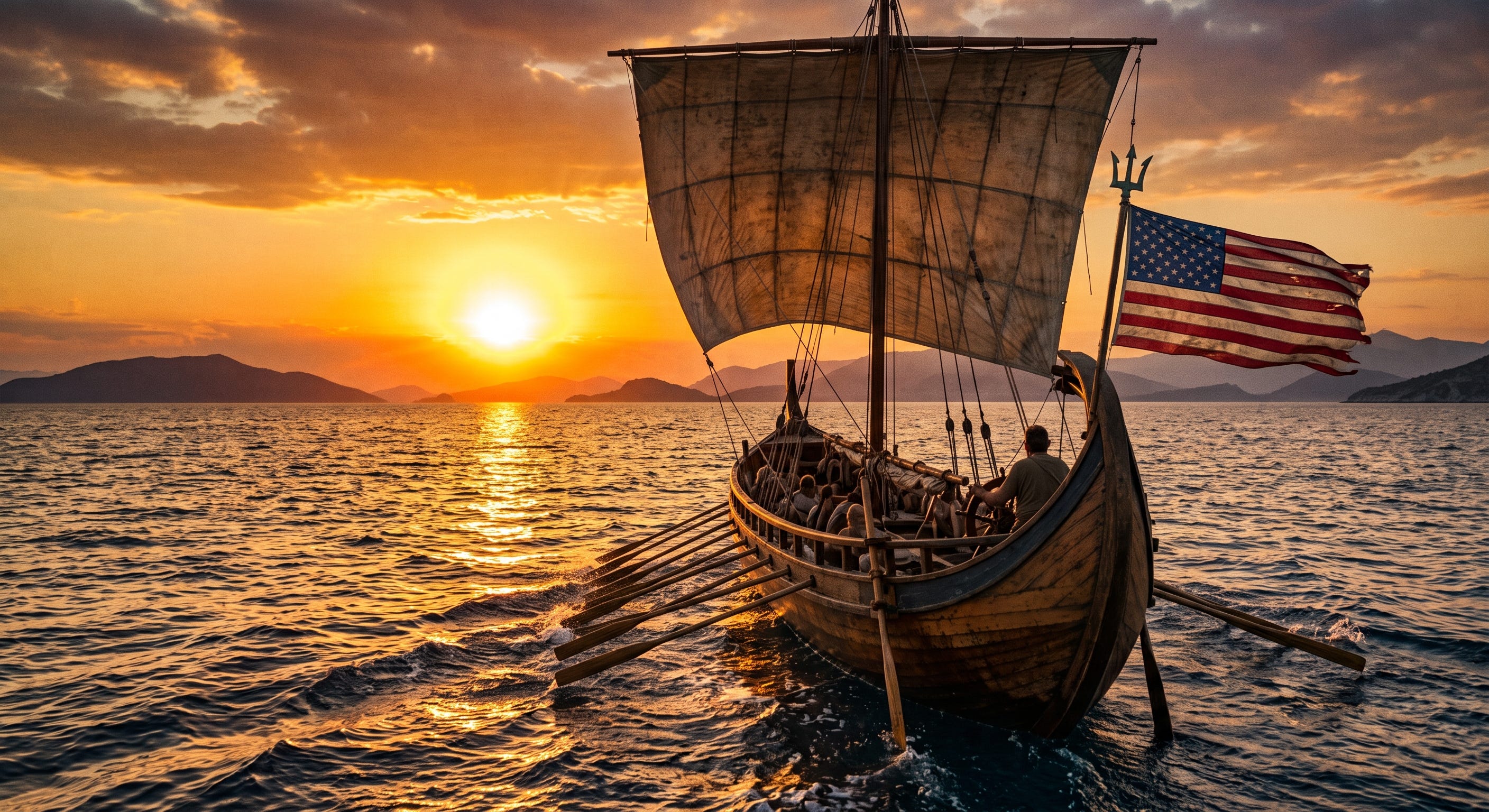
I’m on vacation this week. My summer vacation is at sea, which is fitting, since the movie of the summer, The Odyssey, involves a “hero” on a ship. And so I’m deviating from law and policy in this newsletter to indulge my other passion: cultural criticism (or maybe high-school level classics). What was really going on in the Odyssey? Just know: This newsletter contains spoilers to the extent that is even possible. The movie has been out for 6 weeks and is based on a 3,000-year-old poem, so it’s hard to spoil it.
Homer, or the group of poets writing under that name, composed the Odyssey around 800 BCE. He was writing historical fiction about events roughly 400 years earlier, around 1200 BCE, which is generally treated as the end of the Bronze Age. Archaeology tells us that most of the great civilizations of the eastern Mediterranean, like Mycenaean Greece (where the Odyssey takes place), collapsed about 1200 BCE. We might think of history as linear: 800 BCE, being after 1200 BCE, must have been better than 1200 BCE. That’s a very modern way to think of the world. 800 BCE was most definitely not better than 1200 BCE, and “Homer” knew that. People in 800 BCE were basically living in the ruins of the great civilizations before them. It was actually known as the “Greek Dark Ages.” In retrospect, everything worked out since classical Greece and Rome were still ahead of them, but they would not have known that at the time.
Science teaches us the reason that so many civilizations collapsed around 1200 BCE was climate: a megadrought that ran anywhere from 150 to 300 years, and they also think there were some major earthquakes, and displaced people wreaked havoc on already weakened civilizations. Homer probably did not know that, either. But he knew that something ruined the world. It’s pretty apparent that the Odyssey is an allegory for the collapse of civilization. The traditional understanding of the Odyssey, at least the one that I was taught in high school, is that human hubris brought about vengeful gods that basically ruin everything. That was probably all the folks in Homer’s time needed to understand. Interestingly enough, our culture keeps churning out movies where some environmental stressor brings about the end of the world: the one where the earth freezes over, the two 1998 movies about a comet or asteroid hitting the planet, the satire we made of that a few years back (Don’t Look Up), Cuarón’s Children of Men, which uses a fertility collapse the same way. Our culture does not have vengeful gods, but we always imagine the end coming based on forces beyond human control.
But Christopher Nolan’s Odyssey, the one that has captured the imaginations of Western civilization three thousand years after Homer’s, is not one of those environmental collapse and end-of-the-world movies. It actually does not really have a lot of gods in it (vengeful or otherwise), and those that do appear seem to be a little deflated, to be honest. Rather, the cause for collapse in Nolan’s Odyssey is a civilization undone from within because people kept violating “Zeus’s law.” Zeus’s law is “the sacred law of hospitality between guests and hosts—a weary traveler could expect food, comfort and shelter from friends and strangers alike, the only obligation to be a respectful guest.”
The first and worst violation of Zeus’s law is not actually in the Odyssey, but is the act that legend tells us started the Trojan War and is spoken about a lot in the Odyssey: Paris of Troy is Menelaus of Sparta’s guest and repays that hospitality by running off with his host’s wife, Helen (henceforth known as Helen of Troy). Then Troy’s fall, which is shown in the Odyssey, is wrapped in the same theme from the other side: the Trojan Horse is brought into Troy, and the guests hiding in the Horse end up sacking the city (and Odysseus regrets his role in that betrayal). And then when Odysseus’s men end up being the “guests” of the Cyclops, he eats a few of them, and Odysseus sticks a burning stick in the Cyclops’s one eye and blinds him. By then, everyone is violating Zeus’s law, in the first degree. And then when Odysseus finally reaches home, he slaughters the suitors squatting in his house, who’ve spent three years eating his stores and courting his wife: moochers, and bad guests, in the fullest sense. Zeus’s law would seem to be on his side there, so we sort of cheer when Odysseus slaughters the suitors. But the point is the same: someone is not following Zeus’s law, and havoc ensues. Odysseus is most definitely a recidivist at violating Zeus’s law, even if it seems to be the right thing to do under the circumstances. After all, you reap what you sow.
Homer’s poem ends with the gods forcing a peace on Ithaca to prevent a civil war between the families of the suitors and Odysseus, which is sort of a cop-out. Nolan’s Odyssey actually comes with a more creative, if not muddled, ending: having basically shown that Zeus’s law is ill-suited for his “new” age, the movie concludes by Odysseus gracefully sailing off to the west with his wife, which had the look to me of a well-preserved and rich baby-boomer’s retirement party. The final sail to Mar-a-Lago? And of course, his son, Telemachus (same actor who plays Spider-Man, ironically) is left to clean up the mess and live in this new age his father so graciously bestowed upon him. Good luck to you, Telemachus.
So what is the point? A system built on mutual obligation only survives if people actually honor it, and the people who break that trust rarely stick around to repair it.
And now back to my cruise.
Keep thinking, keep building,
Jesse
Hi, and welcome to my newsletter! I’m Jesse Strauss, Your Fractional General Counsel. I’m a lawyer with a private practice based in New York City, helping clients in the United States and globally with their U.S. legal needs. My expertise spans various areas, including raising funding rounds, employment issues, negotiating master service agreements, intellectual property, compliance, legal process management, and dispute resolution. My focus is on founding and nurturing great companies from seed to exit. Discover more at YFGC.AI and book a complimentary 30-minute consultation. You can also follow me on Threads @lawyerjesse1977, on BlueSky @lawyerjesse.bsky.social, subscribe to my Substack here, and follow me on LinkedIn here.
Originally published at Fractionally Yours, Jesse's Substack.