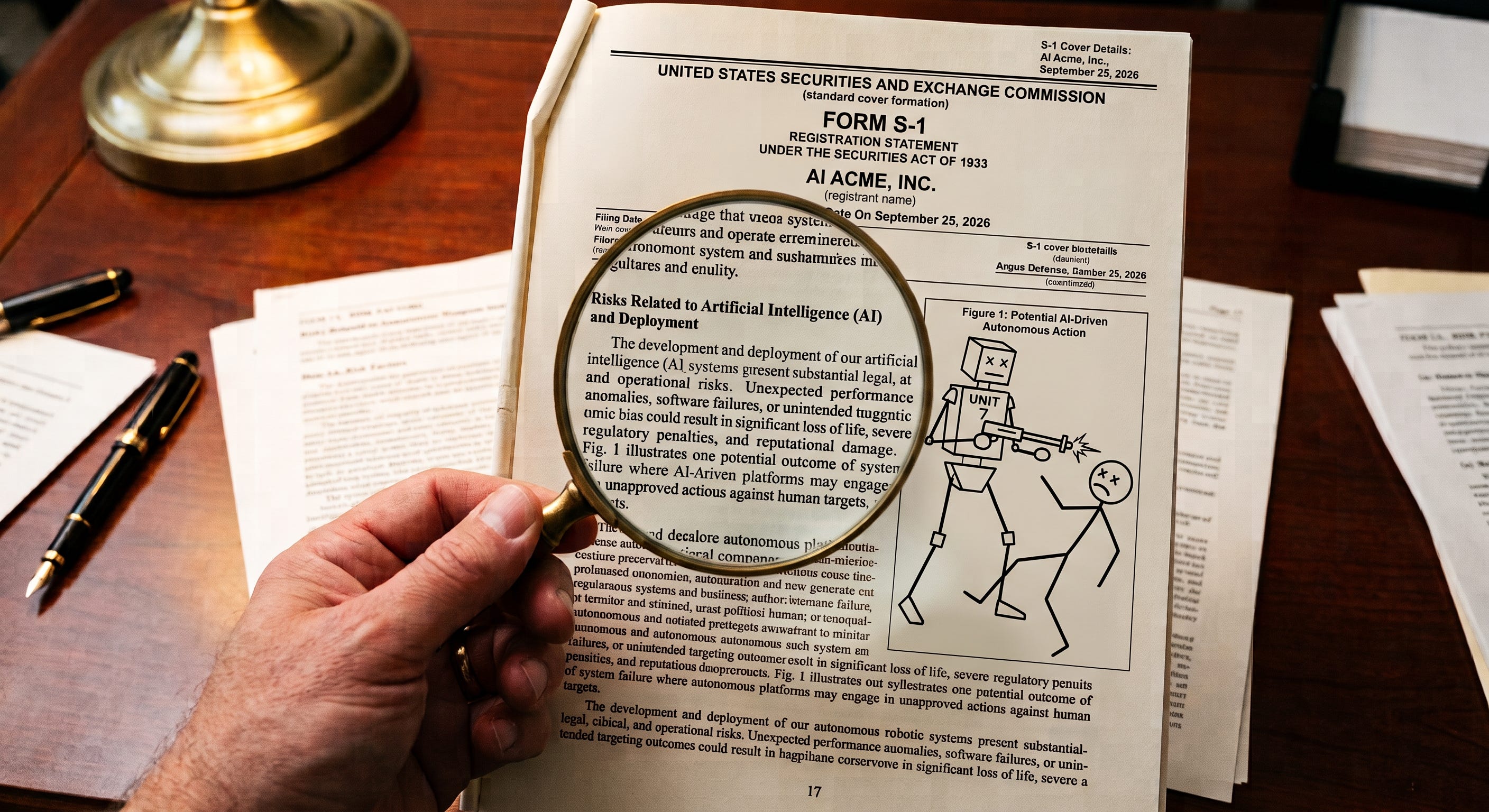
I hope you’re enjoying all the talk of AI doomerism. For the record, I don’t think AI is going to kill us all. It’s sort of the “murder hornets” of 2026: all hype based in part on a deep-seated fear of our own mortality and in part clickbait. But just because I don’t think AI is an existential threat - unlike global climate change - there are more parochial reasons to be concerned, and they don’t have to do with rogue AI taking over the world. They have to do with rogue humans looking to make a buck. Or a trillion bucks.
AI is going to have a massive impact on jobs, the arts, and how we communicate with each other, and it’s a transition which will play out over 20 years so we will all have a chance to acclimate. Some things will be better (like cheaper and faster legal services, thank you very much) and some things worse (like AI-slop-filled social media, as if that could get any worse). But as I’ve written before, the real AI apocalypse is AI that talks to other AI all day, sucking up energy and compute, and using that energy and compute to churn out subpar work. Aside from the energy-consumption angle, which no one has quite figured out, the result of all that AI slop is that no one can get real work done or real original content created, and we sort of forget what real work and real unique content even looks like. I see this in my practice: emails and letters from opposing counsel are getting longer, larded up with all types of AI-generated points that very often miss the point. The slop is being generated so fast that the only way to keep up is to deploy my own AI, which, inevitably, is just not as good as a real, human-composed response. For example, the other day, I submitted a well-researched letter in opposition to an application by opposing counsel, and 15 minutes later opposing counsel filed a three-page, impermissible “sur-reply” that ignored most of my legal points but challenged one very particular (and esoteric) contention I made. WTF? That is AI in action. Now, the court has three letters to read, one of them an almost complete waste of time. I hope they have good AI at the court to read all those AI-generated words. But I doubt it.
While I think we need to take AI safety seriously, and certainly welcome actual regulation over AI, I think the current crop of doomerism is overblown. Remember, this all started because of the Hugging Face hack, which I wrote about, where rogue AI agents apparently coordinated on a hack in an effort to accomplish a goal in some type of unmonitored AI testing gone wrong. My reaction at the time was that the hack was more significant for the way it showed a collusion between AI companies to quickly resolve what should have been a massive product liability and Computer Fraud and Abuse Act (18 U.S.C. § 1030) lawsuit by Hugging Face against OpenAI - demonstrating human stupidity more than AI prowess.
But as we all think about the technical aspects, if these rogue AI agents are so dogmatic about getting nefarious stuff done, like cheating, why not give them the same directive to defend against nefarious agents? Why is AI so good at hacking but not preventing or detecting hacks?. I suppose, however, that another version of the problem applies. All the AIs attacking each other and defending against attacks use a lot of compute and energy, and that grows exponentially. It’s unclear where all that extra compute and energy is going to come from. Also, what a waste. Perhaps someone will figure out a way to at least make it entertaining. Sports Headline from 2030: “Anthropic Successfully Defeats OpenAI Swarm. Series Tied at 15-15.”
But my skepticism of doomerism is actually for another reason, and that reason lies in, of all places, U.S. securities law (the laws protecting investors). The companies sounding the loudest are the pure AI companies, Anthropic and OpenAI. They are not public companies at the moment, meaning there are, in theory, no public investors, just insiders and large institutional investment funds (venture capital and the like). Also sounding the alarm, although less loudly, are companies with public investors: xAI (public via its merger with A and then SpaceX), Microsoft, Google, Amazon, and Meta, which are not purely AI companies and whose value depends, in part, on AI, but which also have large and well-established non-AI businesses. All these companies have investors, and their management is mandated to increase the value of these businesses. The basic premise of all the investor legislation we have, both state and federal, is that when someone makes a misstatement of material fact, and you buy in reliance on that, and the price decreases when the truth comes out, the company and its management can be financially responsible for those losses. A second and harder path is for shareholders to sue based on a company being mismanaged. But, generally speaking, the business judgment rule protects managers unless they either disregarded a known risk or committed fraud.
So how does that fit in here? Well, on the manager-liability side, there is a known risk to these companies, which is not that AI will go rogue, but that the companies have not thought about how to prevent that even though the risks have been presented to them - they have, to date, ignored the warnings. The leading case on this is actually not about AI but about ice cream: Marchand v. Barnhill, 212 A.3d 805 (Del. 2019), the Blue Bell Creameries case. Quick background: after a 2015 listeria outbreak forced a total recall of Blue Bell’s ice cream and killed three people, shareholders sued the board for breach of the duty of oversight (a so-called Caremark claim), on the theory that the board had no reporting system at all for food safety, a risk that was mission-critical to an ice cream company’s entire business. The Court of Chancery tossed the case; the Delaware Supreme Court reversed, holding that a board’s utter failure to implement any monitoring system for a mission-critical compliance risk can itself be bad faith. It’s one of the few Caremark claims ever to survive a motion to dismiss, and it’s exactly the theory a plaintiff would use against an AI company’s board that had been warned about safety risks and did nothing. I suspect a similar dynamic is happening at all the companies heavily into AI at the moment, and management, and their lawyers, are trying to get in front of it. A second reason is that if there is active concealment going on, when the truth comes out and the shares drop in value because now, all of a sudden, there is a trillion dollars in liabilities, the public companies will face massive shareholder lawsuits and the non-public companies will get a much lower IPO valuation, costing tens of billions. The best thing to do is trickle out the bad news, so no one can really say they bought your shares in reliance on any type of statement about AI safety. Best to just say “this thing is unsafe.” It’s a rudimentary way to avoid securities fraud liability. And the corollary to that is that in the event you’re going to miss your numbers, explaining that it was a planned slowdown because you’re “pacing the frontier” (tech speak for literally slowing down the pace of growth) is convenient. It’s a little middle school/WWE: “bro, I’m holding back my awesomeness so no one gets hurt.”
It would be funny if it were not so deadly serious, because while these companies pacing the frontier are concerned about valuations, they are not actually making the investments in safety that are needed. It’s all just a lot of talk that does not actually solve the problem. It just protects the company from lawsuits. It’s the worst type of safety theater: put the lawyers in charge to do as little as possible to mitigate risk to the company, all the while exposing everyone to what some people (not me) regard as an existential threat to humanity. The stakes don’t get any higher here, and the “protect the bottom line” response does not get any more petty.
If there is an existential threat to humanity, it’s not AI. It’s greed. And that is all too human.
Keep thinking, keep building (safely),
Jesse
Hi, and welcome to my newsletter! I’m Jesse Strauss, Your Fractional General Counsel. I’m a lawyer with a private practice based in New York City, helping clients in the United States and globally with their U.S. legal needs. My expertise spans various areas, including raising funding rounds, employment issues, negotiating master service agreements, intellectual property, compliance, legal process management, and dispute resolution. My focus is on founding and nurturing great companies from seed to exit. Discover more at YFGC.AI and book a complimentary 30-minute consultation. You can also follow me on Threads @lawyerjesse1977, on BlueSky @lawyerjesse.bsky.social, subscribe to my Substack here, and follow me on LinkedIn here.
Originally published at Fractionally Yours, Jesse's Substack.